If you’ve seen FAFO online and wondered what it means, you’re not alone.
This short slang term appears everywhere—from text messages and comment sections to TikTok captions and memes.
People search for the FAFO meaning because it looks simple, yet carries a strong message that isn’t always obvious at first glance.
Depending on context, FAFO can sound humorous, sarcastic, or even threatening.
That’s why understanding it properly matters before using or responding to it.
In this article, we’ll break down what FAFO means, where it came from, how it’s used in daily conversations, and how its tone changes across platforms like WhatsApp, Instagram, TikTok, and Snapchat.
Everything is explained clearly, simply, and in a friendly way—no confusion, no guesswork.
What Does FAFO Mean in Text & Chat?
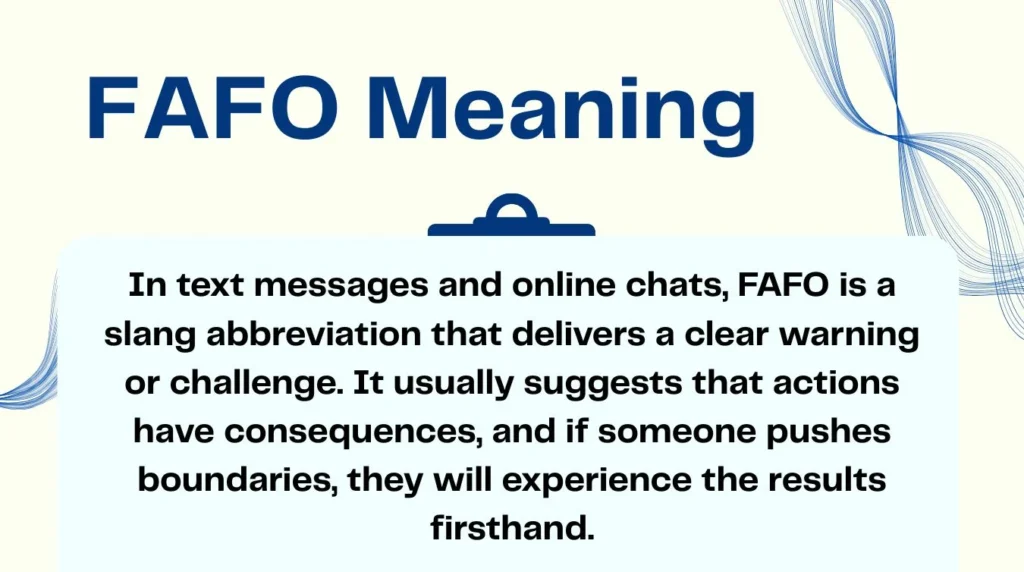
In text messages and online chats, FAFO is a slang abbreviation that delivers a clear warning or challenge. It usually suggests that actions have consequences, and if someone pushes boundaries, they will experience the results firsthand.
FAFO is often used when:
- Someone is being reckless
- A person ignores repeated warnings
- A comment needs emphasis without a long explanation
In casual chats, FAFO can be playful or sarcastic. In heated conversations, it can sound aggressive or confrontational. The tone depends heavily on context and relationship.
Quick chat-style meanings:
- “Go ahead, but don’t complain later”
- “Your actions will have consequences”
- “You’ve been warned”
Because FAFO is blunt, people often use it when they want to end a discussion quickly. It replaces long arguments with a short, powerful statement.
Full Form, Stands For & Short Meaning of FAFO
The full form of FAFO is:
F* Around and Find Out**
The phrase is intentionally direct. It implies that if someone behaves irresponsibly, they will discover the outcome through experience rather than explanation.
Short meaning:
- “Test it and see what happens”
- “Actions lead to consequences”
Important note:
FAFO contains implied profanity, which is why it’s often abbreviated. People use the short form to soften the language while keeping the message strong.
Because of this, FAFO is common in:
- Online slang
- Meme culture
- Comment debates
- Casual but intense conversations
Origin, History & First Known Use of FAFO
The idea behind FAFO is much older than the internet. The phrase evolved from long-standing sayings like:
- “Play foolish games, win foolishd prizes”
- “You’ll learn the hard way”
FAFO became popular online in the late 2010s, especially on forums, gaming communities, and social media platforms. Memes played a major role in spreading it. Images showing warnings followed by consequences often included FAFO as a caption.
Over time, FAFO moved from niche internet slang into mainstream digital language. Today, it’s widely understood, even by people who don’t use slang often.
How People Use FAFO in Daily Conversations
FAFO is used when words feel unnecessary. It’s direct, short, and final.
Common everyday uses:
- Warning a friend jokingly
- Responding to risky behavior
- Ending an argument
Examples:
- “Ignore the instructions if you want—FAFO.”
- “He kept pushing limits and… well, FAFO.”
It can be humorous among friends but harsh among strangers. Knowing your audience matters.
FAFO Meaning Across WhatsApp, Instagram, TikTok & Snapchat
FAFO shifts slightly depending on the platform:
- WhatsApp: Often joking or teasing among friends
- Instagram: Used in captions or comments, sometimes sarcastic
- TikTok: Common in videos showing consequences or “life lessons”
- Snapchat: Casual slang, often playful
On TikTok especially, FAFO is tied to visual storytelling—actions followed by instant results.
Different Meanings of FAFO in Other Fields
FAFO doesn’t have official meanings in academic or professional fields. However, it’s sometimes used metaphorically in:
- Business discussions (risk-taking)
- Sports commentary
- Military or motivational speech
In all cases, the core idea remains the same: consequences follow actions.
Common Confusions, Mistakes & Wrong Interpretations
People often misunderstand FAFO as:
- Encouragement (it’s usually a warning)
- A joke (sometimes it isn’t)
- A threat (not always, but it can sound like one)
Common mistakes:
- Using it in formal settings ❌
- Saying it to strangers without context ❌
- Assuming it’s always funny ❌
Similar Terms, Alternatives & Related Slang
Related slang includes:
- “Play foolish games, win foolish prizes”
- “You’ve been warned”
- “Try it and see”
- “Don’t say I didn’t warn you”
Internal linking suggestion:
- Link to articles on FWIW meaning, IDK meaning, or SMH slang for related abbreviation content.
Examples of FAFO in Real Chat Situations
- “Touch that button again and FAFO 😅”
- “He skipped practice all season—FAFO 🤷♂️”
- “Think rules don’t apply? FAFO.”
How to Reply When Someone Says FAFO
Your response depends on tone:
- Calm: “Got it, I understand.”
- Playful: “Haha, fair enough 😄”
- Defensive: “No need to threaten.”
If it feels aggressive, it’s okay to disengage.
Is FAFO Still Popular? Trends & Online Usage
Yes, FAFO is still widely used. It remains popular because:
- It’s short and memorable
- It fits meme culture
- It replaces long explanations
As long as online slang evolves, FAFO is likely to stay relevant.
FAQs About FAFO Meaning
1. Is FAFO rude?
It can be, depending on tone and context.
2. Can FAFO be used jokingly?
Yes, especially among friends.
3. Is FAFO safe for work?
Not really—best avoided in professional settings.
4. Does FAFO always imply a threat?
No, sometimes it’s just a warning.
5. Why do people abbreviate FAFO?
To avoid explicit language while keeping the meaning strong.
Conclusion
The FAFO meaning is simple but powerful. It’s a modern slang term that warns about consequences without overexplaining.
Whether used humorously or seriously, FAFO reflects how online language favors brevity and impact.
Understanding its tone, context, and platform usage helps you avoid misunderstandings and respond appropriately.
While it’s not suitable for formal conversations, FAFO remains a popular part of internet culture because it says a lot with very few words.
If you come across it again, you’ll know exactly what message is being sent—and how to handle it confidently.

Joseph Henry is the creative mind behind PunsMarkete, spreading smiles one clever pun and joke at a time. He believes laughter is the shortest distance between people.