If you’ve ever received a message that simply says “IDC”, you might have paused for a second wondering what it meant.
You’re not alone. Many people search for “IDC meaning in text” because online conversations move fast, and abbreviations save time — but they can also cause confusion.
IDC is one of those short, casual expressions that shows up in texting, social media comments, gaming chats, and group conversations.
Sometimes it sounds chill, sometimes it sounds dismissive, and sometimes it depends entirely on tone.
In this guide, we’ll break down exactly what IDC means, where it came from, how people use it today, and how to respond without misunderstanding the vibe.
Let’s decode this tiny but powerful bit of internet language.
What Does IDC Mean in Text & Chat?
In texting and online chat, IDC stands for “I Don’t Care.”
It’s commonly used to express:
- Indifference
- Lack of preference
- Emotional detachment
- Casual agreement without strong opinion
The tone of IDC depends heavily on context. It can sound relaxed and easygoing — or blunt and rude.
Friendly Use Example
- “Pizza or burgers?”
→ “IDC, you choose 🙂”
Here, it means “I’m okay with anything.”
Dismissive Use Example
- “Did you hear what happened?”
→ “IDC.”
This version can feel cold or uninterested.
Because tone is hard to read in text, IDC can sometimes be misunderstood. That’s why people often add emojis or extra words to soften it.
Full Form, Stands For & Short Meaning of IDC
Full Form: I Don’t Care
Short Meaning: No strong opinion, not concerned, emotionally neutral
People use IDC when:
- A decision doesn’t matter to them
- They want someone else to decide
- They don’t feel emotionally invested
- They want to end a topic quickly
It’s popular because it’s fast to type and easy to understand — at least for people familiar with texting slang.
Quick Meanings at a Glance
- Neutral → “I have no preference”
- Lazy reply → “You decide”
- Dismissive → “Not interested”
- Emotional distance → “This doesn’t affect me”
So while IDC looks simple, the real meaning often depends on the situation and the relationship between the people chatting.
Origin, History & First Known Use of IDC
IDC emerged during the early days of internet chatrooms and SMS texting in the late 1990s and early 2000s. Back then, character limits and slow typing speeds made abbreviations essential.
Just like LOL (Laugh Out Loud) and BRB (Be Right Back), IDC became part of digital shorthand culture. Teens and young adults were the first to widely adopt it in instant messaging apps like:
- AIM (AOL Instant Messenger)
- MSN Messenger
- Yahoo Chat
As texting grew on mobile phones, IDC spread even faster. When social media platforms like Facebook, Twitter, and later Instagram and TikTok appeared, the abbreviation stuck around.
Today, IDC is used globally in English-speaking online spaces. It’s no longer just teen slang — adults use it too, especially in casual chats.
How People Use IDC in Daily Conversations
IDC appears in everyday digital conversations when people want to stay low-effort or emotionally neutral.
Common Situations
1. Making Plans
- “Movie or dinner?”
→ “IDC, both sound good.”
2. Group Decisions
- “What color should we choose?”
→ “IDC, I trust you guys.”
3. Avoiding Drama
- “He said something about you.”
→ “IDC honestly.”
4. Showing Disinterest
- “Guess who texted me!”
→ “IDC 😐”
Notice how tone changes meaning. Adding words like “honestly” or emojis can make it softer or harsher.
IDC Meaning Across WhatsApp, Instagram, TikTok & Snapchat
The meaning of IDC stays the same across platforms, but tone and style differ.
Usually casual and friendly among friends.
- “Where should we eat?” → “IDC lol”
Instagram DMs
Often used in relaxed conversations.
- “Do you like this filter?” → “IDC, you look good anyway”
TikTok Comments
Can sound sarcastic or blunt.
- “IDC this trend is weird.”
Snapchat
Used quickly in short chats.
- “Red or blue?” → “idc”
Lowercase “idc” often feels more casual, while uppercase “IDC” can feel stronger or more serious.
Different Meanings of IDC in Other Fields
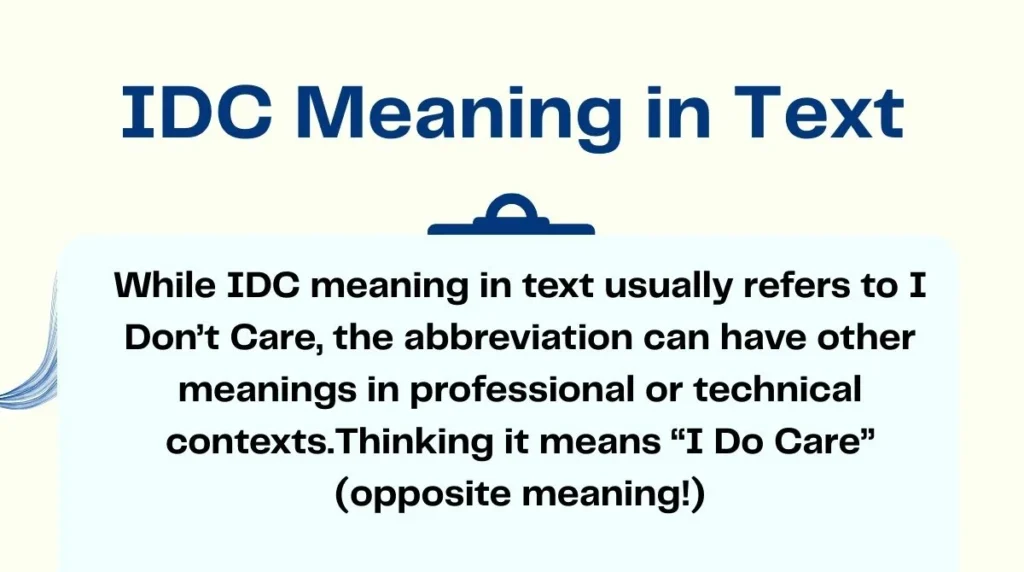
While IDC meaning in text usually refers to I Don’t Care, the abbreviation can have other meanings in professional or technical contexts.
Examples include:
- International Data Corporation (technology research company)
- Industrial Development Corporation
- Internet Data Center
However, in everyday messaging and social media, almost everyone understands IDC as I Don’t Care.
Context makes it clear whether someone is talking about business or just texting casually.
Common Confusions, Mistakes & Wrong Interpretations
Some people misread IDC, especially if they’re new to texting slang.
Common Confusions
- Thinking it means “I Do Care” (opposite meaning!)
- Reading it as anger when it’s just neutral
- Assuming rudeness when the sender just means “no preference”
Tone Problems
Without voice or facial expression, IDC can feel:
- Cold
- Uninterested
- Passive-aggressive
That’s why people sometimes write:
- “IDC haha”
- “I don’t mind”
- “IDC either way 🙂”
These soften the message.
Similar Terms, Alternatives & Related Slang
If someone doesn’t want to use IDC, they might say:
- IDM – I Don’t Mind
- Whatever – Casual but can sound rude
- Up to you – Polite alternative
- Doesn’t matter – Neutral
- Meh – Indifferent feeling
Compared to these, IDC is shorter but more emotionally flat.
Examples of IDC in Real Chat Situations
Here’s how IDC shows up in real conversations:
- Friend: “Coffee or tea?”
You: “IDC ☕” - Sibling: “Want to watch this show?”
You: “IDC, you pick” - Friend: “He was talking about you again.”
You: “IDC honestly” - Group Chat: “Where should we go?”
You: “idc lol”
These examples show neutral, casual, and dismissive tones.
How to Reply When Someone Says IDC
Your response depends on context.
If They Mean “No Preference”
- “Okay, I’ll decide then!”
- “Cool, I’ll pick 😊”
If They Sound Dismissive
- “Alright, no worries.”
- Change topic
If You Need a Clear Answer
- “I know you don’t mind, but which do you slightly prefer?”
Reading the mood helps avoid misunderstandings.
Is IDC Still Popular? Trends & Online Usage
Yes — IDC is still widely used in texting and social media. While Gen Z uses newer slang constantly, classic abbreviations like IDC remain common because they’re simple and useful.
It appears frequently in:
- Casual texting
- Gaming chats
- Social media comments
- Group planning conversations
Even with emojis and voice notes becoming popular, quick abbreviations like IDC aren’t going anywhere.
FAQs About IDC Meaning in Text
1. Is IDC rude?
It can sound rude if used alone. Adding emojis or extra words makes it softer.
2. Does IDC always mean “I Don’t Care”?
In texting, yes. In business or tech, it can mean other things.
3. What’s the difference between IDC and IDM?
IDC = I Don’t Care. IDM = I Don’t Mind (more polite).
4. Why do people say IDC instead of full words?
It’s faster and fits casual online communication.
5. Is IDC used by adults too?
Yes, especially in informal messages.
Conclusion
Understanding IDC meaning in text helps you avoid awkward misunderstandings in online conversations.
While it simply stands for “I Don’t Care,” the tone can range from relaxed and flexible to distant or blunt. Context, relationship, and added emojis often shape how it’s received.
Whether you’re chatting with friends, replying in a group, or scrolling through social media comments, knowing how IDC works makes digital communication smoother.
And if you ever worry it sounds too harsh, switching to “I don’t mind” or “up to you” can keep things friendly.
Tiny abbreviation — big impact. Now you’ll never be confused by IDC again.

Joseph Henry is the creative mind behind PunsMarkete, spreading smiles one clever pun and joke at a time. He believes laughter is the shortest distance between people.