In today’s fast-paced digital world, acronyms fly across texts, chats, and social media faster than we can blink.
One of the most common—and sometimes confusing—slang terms you’ll encounter is “STFU”.
If you’ve ever seen it in a message and wondered whether it’s a joke, an insult, or something else entirely, you’re not alone.
People search for “STFU meaning in text” every day to decode its meaning, origin, and proper usage.
Understanding this term is helpful not just for teens and social media enthusiasts but for anyone navigating modern online conversations.
In this guide, we’ll break down what STFU means, how it’s used, its history, and tips on replying if someone drops it in your chat. Let’s dive in—without yelling… too much. 😅
What Does STFU Mean in Text & Chat?
In the simplest terms, STFU is an acronym used in texting and online chats to express a strong desire for someone to stop talking. It’s short, sharp, and often comes across as rude or blunt.
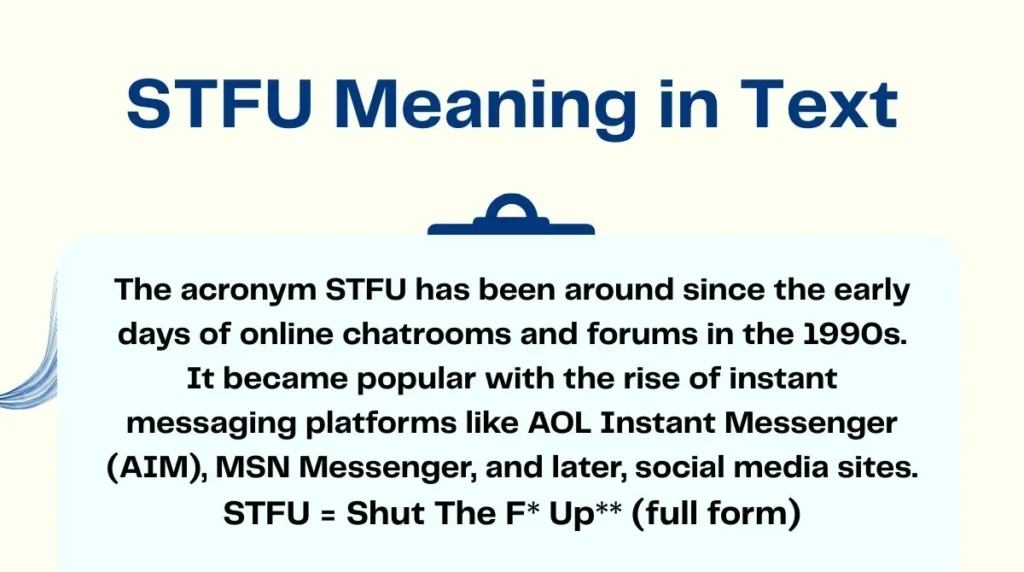
- STFU = Shut The F* Up** (full form)
- Commonly used in casual text messages, DMs, group chats, and comment sections.
- Typically conveys annoyance, frustration, or humor depending on context.
💡 Quick example:
- Friend: “I can’t believe you did that again!”
- You: “STFU 😂” (used playfully to tease)
While it might sound harsh, context is everything. Among friends, it can be joking or sarcastic; in other settings, it can be genuinely offensive.
Full Form, Stands For & Short Meaning of STFU
Breaking it down:
- Full Form: Shut The F*** Up
- Short Meaning: Stop talking immediately.
- Tone: Can range from playful teasing to outright anger.
✅ Quick shorthand examples:
- “STFU, that’s hilarious!” (playful)
- “STFU, I’m busy.” (serious)
- “STFU!” (angry, abrupt)
Because it’s direct, it’s usually not recommended in professional or formal communication. Stick to safer alternatives in work emails or serious chats.
Origin, History & First Known Use of STFU
The acronym STFU has been around since the early days of online chatrooms and forums in the 1990s. It became popular with the rise of instant messaging platforms like AOL Instant Messenger (AIM), MSN Messenger, and later, social media sites.
- First known use: Late 1990s in online forums.
- Spread rapidly in the 2000s with texting culture.
- Its use skyrocketed with social media apps like Twitter, Instagram, and TikTok.
The term’s bluntness reflects the “internet culture” of being direct and often humorous while exaggerating reactions for effect.
How People Use STFU in Daily Conversations
STFU isn’t just a random insult—it’s a tool for expressing emotion. People use it to:
- Show annoyance: “STFU, you’re being dramatic.”
- Express humor: “STFU 😂 I didn’t know that!”
- React to surprises: “STFU! No way!”
💬 Texting examples:
- “STFU, you actually did that?”
- “Omg STFU 😂 that’s amazing!”
- “STFU, I don’t want to hear it right now.”
Tone and context matter—friends might laugh, but strangers might take offense.
STFU Meaning Across WhatsApp, Instagram, TikTok & Snapchat
Social media has amplified STFU usage:
- WhatsApp: Quick replies in personal or group chats.
- Instagram: Comment reactions or DMs; often paired with emojis.
- TikTok: Comments reacting to shocking videos or trends.
- Snapchat: Snaps or chat messages, often playful or sarcastic.
📌 Example on TikTok:
- Comment: “STFU 😂 This dance is nonsensical!”
It’s mostly informal, so users mix it with humor, memes, and emojis to soften the tone.
Different Meanings of STFU in Other Fields
While STFU almost always means “Shut The F*** Up” online, in niche professional or technical contexts, it can mean something else—but rarely in casual conversation. For instance:
- Military slang: Sometimes used as shorthand for unit names or instructions (rare).
- Gaming communities: Mainly keeps the original meaning, applied to teammates.
For everyday texting, you can safely assume it’s the “stop talking” version.
Common Confusions, Mistakes & Wrong Interpretations
STFU can easily be misunderstood:
- Some may think it’s a friendly joke when it’s meant aggressively.
- People unfamiliar with acronyms might confuse it with STF, STFA, etc.
- Misusing it in formal or professional chats is considered rude.
💡 Tip: If you’re unsure how someone will take it, avoid using it.
Similar Terms, Alternatives & Related Slang
Other acronyms and phrases similar to STFU include:
- GTFO – Get The F*** Out
- SHUT UP – straightforward text version
- STF – less common, sometimes seen in gaming
- Hush – mild, polite alternative
✅ Using emojis often helps soften the blow, e.g., “STFU 😂” vs. plain “STFU.”
Examples of STFU in Real Chat Situations
- Friend teasing:
- “You really ate the whole cake?!”
- “STFU 😂 I couldn’t resist!”
- Annoyed response:
- “Can you stop sending memes?”
- “STFU, seriously 😒”
- Surprised reaction:
- “I got tickets to the concert!”
- “STFU! That’s awesome 😱”
How to Reply When Someone Says STFU
Responding depends on tone:
- Playful: “Lol okay, okay 😅”
- Annoyed: “Fine, I’ll stop.”
- Sarcastic: “STFU, you said it first 😏”
Reading the context and relationship is key—your reply can be funny, neutral, or apologetic.
Is STFU Still Popular? Trends & Online Usage
Yes! STFU remains widely recognized and used in casual digital conversations, especially among younger audiences. While some acronyms fade over time, STFU endures due to:
- Its brevity and directness.
- Easy use across platforms (WhatsApp, TikTok, Snapchat).
- Cultural meme and humor references.
💡 However, younger Gen Z slang may include newer acronyms like Sksksk, so usage can vary by platform and age group.
FAQs About STFU
Q1: Is STFU rude?
- Usually yes, but tone and context can make it funny or playful.
Q2: Can I use STFU in professional messages?
- No, it’s considered highly informal and unprofessional.
Q3: What’s the difference between STFU and SHUT UP?
- STFU is stronger, often more vulgar, and used online or in texting.
Q4: Are there polite alternatives to STFU?
- Yes: “Please be quiet,” “Hush,” or “Let’s take a break from talking.”
Q5: Where is STFU most commonly used?
- Social media, texting apps, gaming chats, and memes.
Conclusion
Understanding STFU meaning in text is a small but essential step in decoding modern digital conversations.
While it’s short, its impact can be big—funny, shocking, or rude depending on how it’s used.
Always read the context and consider your relationship with the person sending it.
Remember, online acronyms like STFU thrive on tone, timing, and emojis, making them versatile in both casual and humorous chats.
Now you can confidently recognize STFU, know when to laugh, and respond appropriately without feeling lost in translation.

Joseph Henry is the creative mind behind PunsMarkete, spreading smiles one clever pun and joke at a time. He believes laughter is the shortest distance between people.